


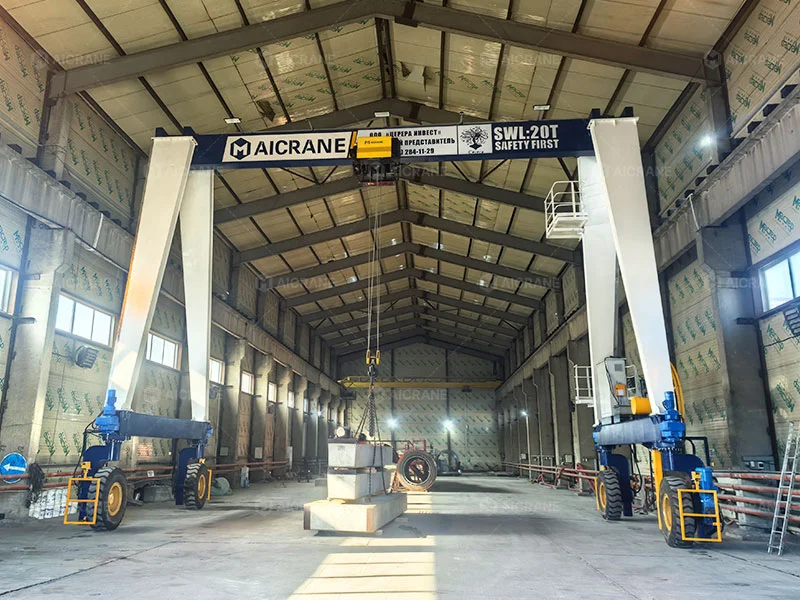
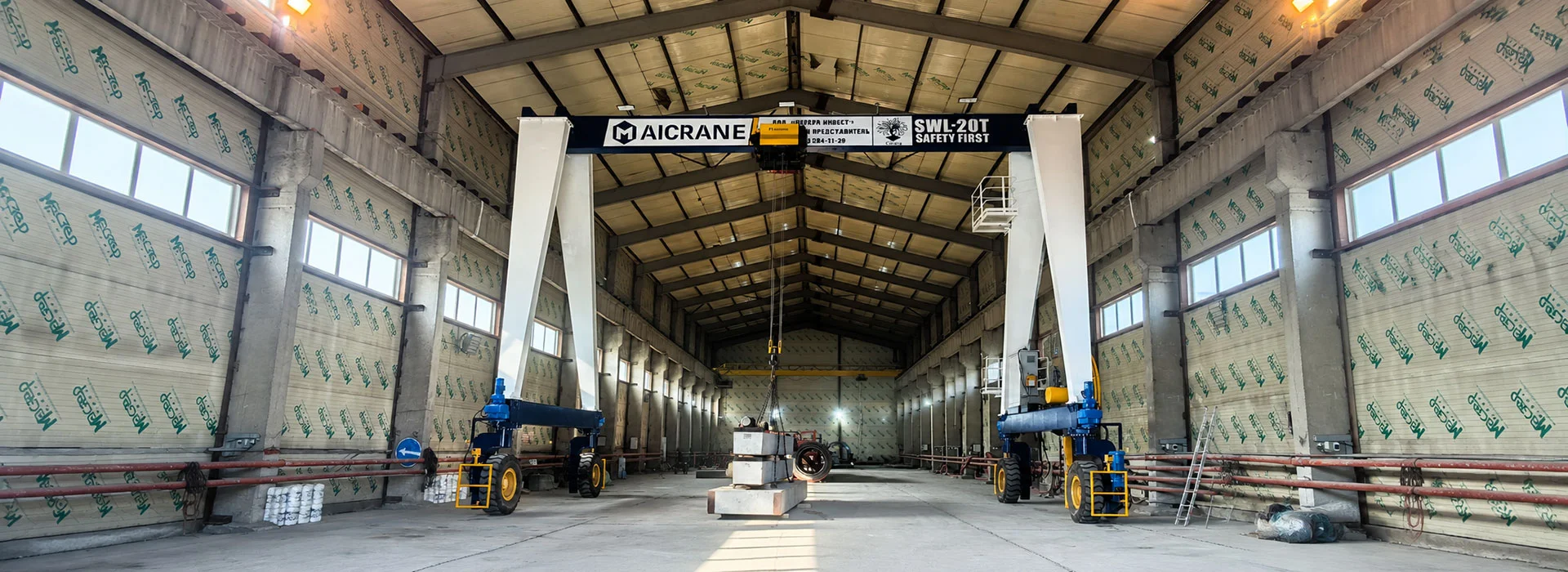
Warehouse gantry crane is ideal for warehouses where overhead bridge cranes cannot be installed due to structural limitations or where runway beam construction is not preferred, as it involves higher civil costs such as support columns and rail beams. With minimal building modification required, they provide flexible and often mobile lifting solutions to improve space utilization and efficiency.
Warehouse Gantry Crane Types and Technical Specifications
Warehouse gantry cranes are available in several configurations, each designed to meet different load capacities, warehouse sizes, and operational requirements.
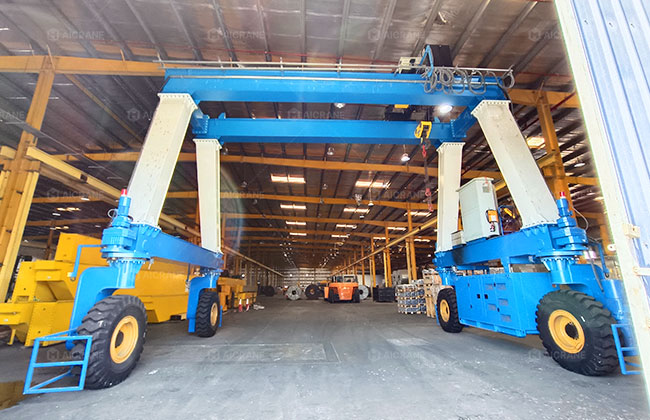
Rubber-Tyred Mobile Type – Flexible and Multi-Zone Warehouses
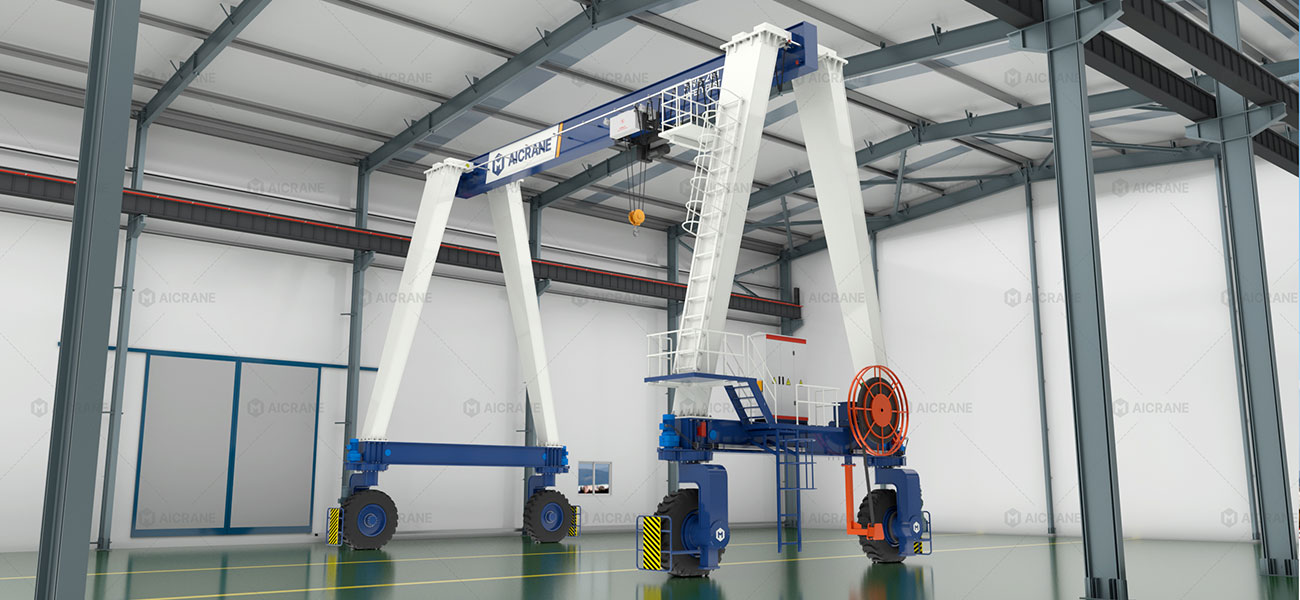
Mobile rubber tyred gantry cranes are often used in warehouses or storage yards where flexible movement is required without fixed runway structures. They can operate across different working zones and are suitable for facilities with changing layouts, temporary storage areas, or multi-point loading and unloading operations, provided that floor conditions and load distribution are properly considered.
- Load capacity: 10-500t (Customizable)
- Span: 5-35m (Customizable)
- Lifting height: 6-18m (Customizable)

Double Girder – Heavy Loads and High-volume Warehouses
Warehouse double girder gantry cranes are widely used for higher lifting capacities and more intensive working conditions. They are suitable for handling steel, machinery, and large components, and are also selected in some operations where greater structural strength, stability, or future load expansion is required.
- Load capacity: 10-500t (Customizable)
- Span: 18-35m (Customizable)
- Lifting height: 6-18m (Customizable)

Single Girder – Light Duty and Compact Warehouses
Single girder warehouse gantry cranes are commonly used for light to medium-duty material handling tasks in warehouses with relatively limited lifting requirements. They are often applied to the movement of pallets, small equipment, and general goods, especially in facilities where space efficiency is a key consideration.
- Load capacity: 5-20t (Customizable)
- Span: 8-35m (Customizable)
- Lifting height: 6-18m (Customizable)
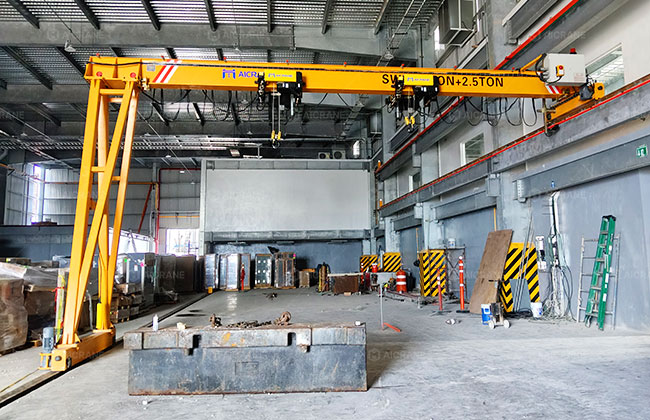
Semi Gantry – Space-Limited or Partially Equipped Warehouses
Semi gantry cranes are commonly applied in warehouses where full overhead crane systems are not practical or where only partial runway structures are available. They are suitable for narrow aisles, edge-mounted lifting areas, or facilities that require a combination of fixed and ground-supported crane operation.
- Load capacity: 5-20t (Customizable)
- Span: 8-30m (Customizable)
- Lifting height: 6-18m (Customizable)
Quick Comparison
| Crane Type | Best Use Case | Structural Requirement | Key Advantage |
|---|---|---|---|
| Rubber-Tyred | Flexible layouts, leased facilities | No runway beams, floor operation | High mobility & relocatable asset |
| Double Girder | Heavy-duty loads, high-frequency lifting | Fixed ground rails + foundation support | Maximum rigidity & structural stability |
| Single Girder | Light-to-medium material handling | Standard rail structure | Cost-efficient & compact footprint |
| Semi Gantry | Narrow aisles, wall-adjacent storage | Single elevated runway support | Space-saving hybrid layout |
Customization Options for Warehouse Gantry Cranes
Every warehouse operates differently. Material types, storage layouts, load weights, and handling frequencies all influence crane design. AICRANE customizes warehouse gantry cranes to match specific facility requirements, helping improve space utilization, lifting efficiency, and operational safety.

Load Handling Attachments for Different Warehouse Materials
Different materials require different lifting attachments to ensure safe and efficient handling.
- Adjustable Spreaders & Slings – Suitable for palletized goods, heavy dies, machinery components, and oversized crates.
- Electro-Magnetic Lifters – Enable fast, rigging-free handling of steel plates, sheet metal, and ferrous materials.
- Coil Grabs, Pipe Clamps & Bundle Grabs – Designed for warehouses storing steel coils, pipes, tubes, timber bundles, and other long materials.
- Vacuum Lifting Systems – Provide damage-free handling of glass panels, aluminum sheets, and polished metal products.
Selecting the appropriate attachment improves load security, reduces manual handling, and protects valuable materials during transport.
Structural Customization for Warehouse Space Constraints
Warehouse gantry cranes can be engineered to fit existing building dimensions and operational requirements.
- Customized Span and Lifting Height – Configured to match aisle widths, storage rack layouts, and ceiling clearances.
- Low-Headroom Hoists – Maximize available lifting height in facilities with restricted overhead clearance.
- Reinforced Box Girders – Provide additional strength and stiffness for handling heavy molds, dies, and industrial components.
- Synchronized Dual-Hoist Systems – Deliver stable two-point lifting for long, oversized, or asymmetrical loads.
These customizations allow the crane to integrate seamlessly into existing warehouse infrastructure without major facility modifications.
Mobility Solutions for Flexible Warehouse Layouts
For warehouses with changing workflows or multiple operating zones, mobility options can significantly improve material flow.
- Rubber-Tyred Mobility Systems – Allow warehouse gantry cranes to move freely between storage areas without rail installation.
- Multi-Directional Steering – Includes crab steering, diagonal travel, and pivot turning for operation in narrow aisles and confined spaces.
- Semi-Gantry Configurations – Utilize one elevated runway and one floor-supported leg to accommodate obstacles or limited floor space.
These mobility features help maximize usable warehouse space while maintaining efficient load transportation.
Advanced Control Systems for Precise Warehouse Handling
Modern warehouse operations often require accurate positioning and high-frequency lifting cycles.
- Variable Frequency Drive (VFD) Control – Enables smooth acceleration, deceleration, and precise load positioning.
- Electronic Anti-Sway Technology – Helps reduce load swing during travel and positioning operations.
- Wireless Remote Controls – Improve operator visibility and keep personnel away from busy forklift routes.
- Real-Time Load Monitoring – Provides continuous load measurement and overload protection.
These intelligent control features improve operational efficiency while supporting safe day-to-day warehouse handling.
Environmental Adaptations for Specialized Warehouse Conditions
Some warehouse environments require additional protection to ensure long-term equipment reliability.
- Corrosion-Resistant Protection Systems – Suitable for chemical storage facilities, fertilizer warehouses, and humid environments.
- High-Temperature Components – Designed for warehouses associated with foundries, metal processing plants, and heat-intensive operations.
- Low-Noise Drive Systems – Ideal for logistics centers, distribution hubs, and indoor facilities where noise control is important.
These adaptations help maintain consistent crane performance under challenging operating conditions.
Power Supply Options for Safe and Reliable Operation
Power delivery systems can also be customized according to warehouse layout and travel requirements.
- Enclosed Conductor Rail Systems – Provides stable and continuous power transmission without exposed cables. Commonly used in fixed-path gantry crane systems for indoor warehouse applications.
- Motorized Cable Reel System – Suitable for mobile gantry cranes or long travel distances. The system automatically manages cable winding and unwinding to ensure safe and organized power supply during operation.
- Diesel / Hydraulic Power System (Optional for RTG) – Used in fully mobile rubber-tyred gantry cranes where external power supply is not available. Provides independent power for outdoor or multi-zone operations.
- Drive System Integration (VFD Control) – Variable frequency drive (VFD) systems improve motor control accuracy, reduce mechanical stress, and ensure smooth crane acceleration and braking.
These power supply options support reliable, safe, and efficient warehouse crane operation.
Project Cases: How Customized Warehouse Gantry Cranes Solve Real Handling Challenges
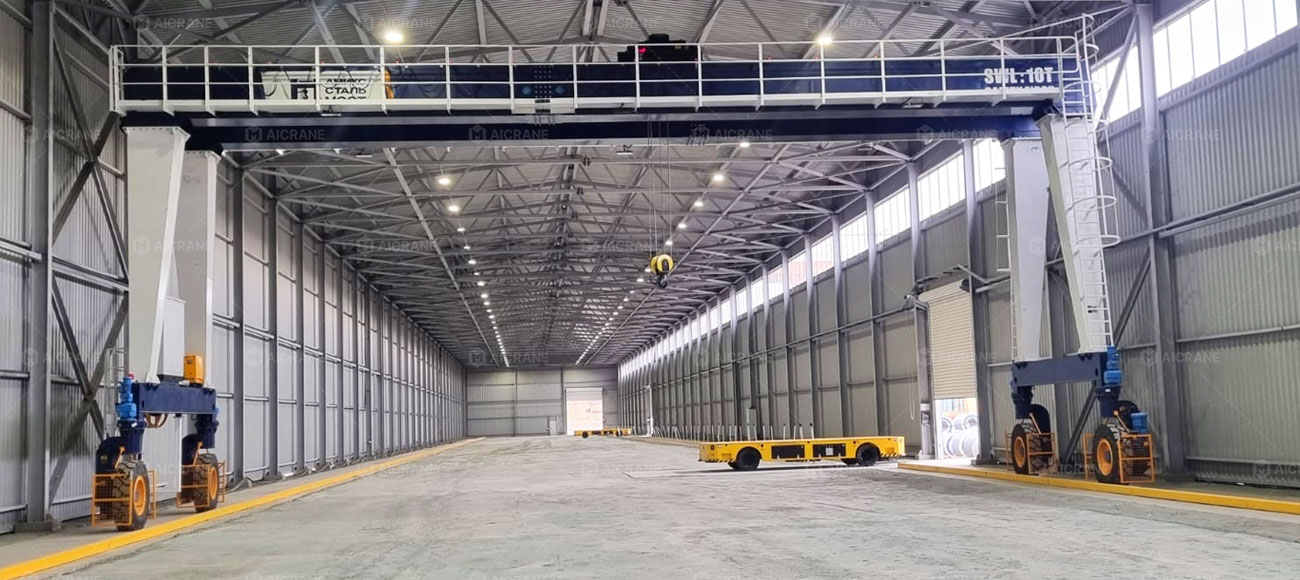
10-Ton Rubber Tyred Gantry Crane for a Steel Coil Warehouse in Russia
The Challenges & Constraints:
A steel products manufacturer required an indoor lifting system for handling high-density steel coils and plates.
The initial overhead crane proposal was rejected due to high civil construction costs, longer installation time, and reduced usable warehouse width caused by runway beams and concrete corbels.
The client requested a ground-running solution with bridge-crane-level precision, maximum span utilization.
The Engineering Solution:
Aicrane designed a 10-ton double girder rubber tyred gantry crane operating directly on the warehouse floor.
The system uses a cable reel power supply, ensuring continuous operation without battery limitations in cold environments.
The double girder structure improves rigidity and reduces deflection during heavy steel coil handling, ensuring stable and precise lifting performance.
Key Technical Advantages:
- No Civil Construction Required: Eliminates the need for runway beams and concrete corbels, reducing construction cost and shortening project delivery time.
- Maximized Warehouse Utilization: Ground-running design allows operation close to warehouse walls, improving usable span coverage.
- High Structural Stability: Double girder configuration ensures better rigidity and controlled deflection under concentrated coil loads.
- Reliable Cable Power System: Provides continuous operation without battery downtime or performance degradation in low temperatures.
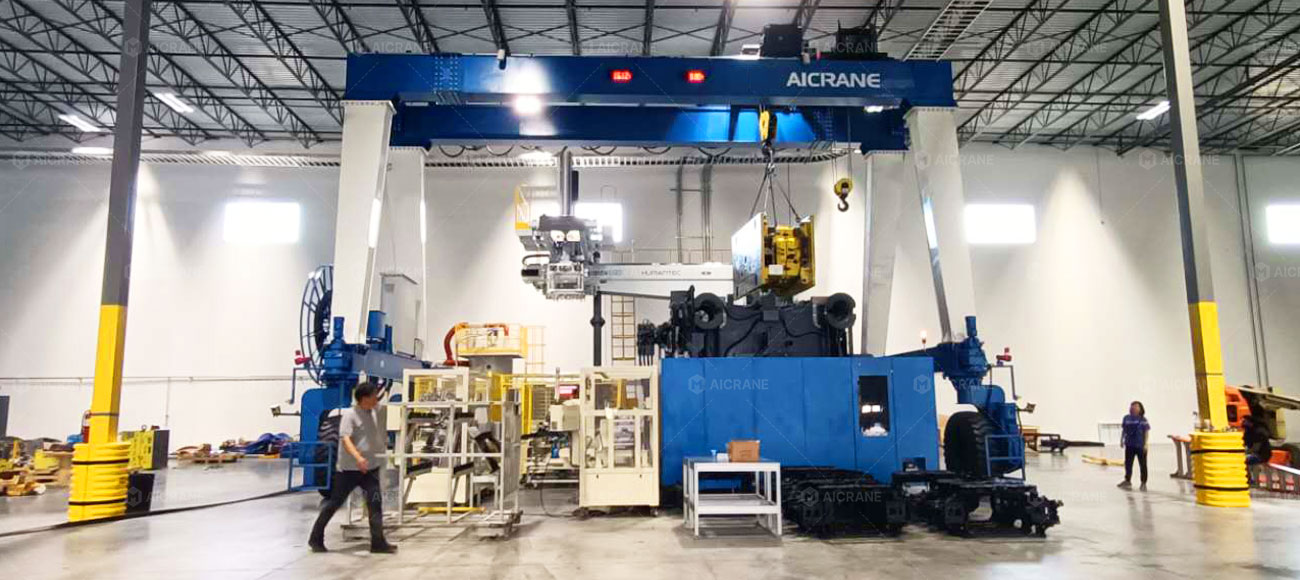
32/20-Ton Warehouse Gantry Crane for a US Automotive Parts Facility
The Challenges & Constraints:
A US automotive parts manufacturer required a reliable lifting solution for handling heavy injection molds inside a leased warehouse environment.
However, the facility came with strict restrictions: no floor anchoring, no rail installation, and no modifications to structural columns were allowed. These limitations made conventional fixed gantry crane systems impractical and risked reducing operational flexibility for future relocation.
The Engineering Solution:
Aicrane provided a custom-designed 32/20-ton rubber-tyred gantry crane with an 11.7m span, 7.7m lifting height, and 9.5m overall clearance.
To support complex mold handling tasks, the system was engineered with a dual-hoist configuration, enabling synchronized lifting, tilting, and controlled rotation of asymmetrical injection molds. This significantly improved positioning accuracy during maintenance and tooling changeovers.
Key Technical Advantages:
- Freestanding, No-Rail Installation Design: Rubber-tyred mobility eliminates the need for rails or foundation anchoring, making the system fully compatible with leased warehouse conditions.
- Flexible & Relocatable Operation: The crane can be quickly dismantled and relocated, allowing the customer to preserve capital investment when moving or expanding production sites.
- High-Precision Load Handling: The dual-hoist synchronization system reduces load swing and ensures stable control during mold rotation and repositioning, improving both safety and operational efficiency.
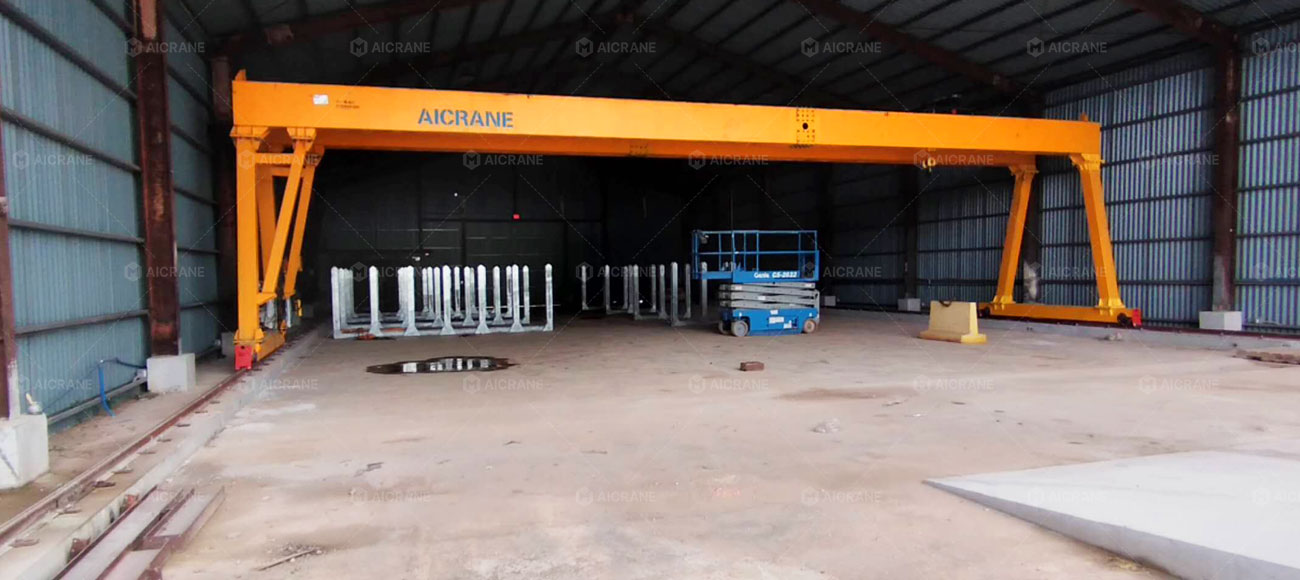
5-Ton Double Girder Gantry Crane for a Precast Component Warehouse in Guam
Challenges & Constraints:
The precast warehouse in Guam had limited building height, leaving very little clearance between the floor and roof structure.
The client also required a lifting solution that would not involve any structural modification, including roof reinforcement or installation of overhead runway beams.
The Engineering Solution:
Based on detailed warehouse drawings and lifting requirements provided by the client, Aicrane designed a 5-ton double girder gantry crane with a 16.4m span and 4.415m lifting height.
The crane was engineered as a compact configuration to fully adapt to the low-headroom environment, ensuring optimal hook travel while maintaining structural stability and smooth operation inside the warehouse.
Key Technical Advantages:
- Optimized for Low Headroom Warehouses: The compact double girder structure maximizes lifting height within strict building height limitations.
- No Structural Modification Required: The freestanding gantry crane design eliminated the need for reinforcing the building or installing a bridge crane system.
- Cost-Efficient Alternative to Overhead Crane Systems: Compared to installing a runway beam or upgrading the building structure, the gantry crane provided a faster, more economical, and less disruptive lifting solution.

12-Ton Single Girder Gantry Crane for a Rubber Products Warehouse in Qatar
Challenges & Constraints:
The warehouse layout in this Qatar facility left very limited flexibility for integrating lifting equipment.
The building structure could not be modified, and the roof trusses were not designed to carry any additional lifting loads. At the same time, the client needed a practical solution for handling rubber materials within a confined storage zone.
During the site evaluation stage, it became clear that a full-span overhead crane system would require structural reinforcement, which was not economically viable for this project.
The Engineering Solution:
Based on the actual workflow requirements, Aicrane proposed a 12-ton single girder gantry crane with an 8.65m span and 6m lifting height, configured specifically for indoor aisle operation.
Instead of covering the entire warehouse bay, the crane was designed for localized material handling, allowing operators to move rubber products between defined work zones efficiently.
This freestanding configuration eliminated the need for runway beams and avoided any dependency on the building structure.
Key Technical Advantages:
- Freestanding Operation Without Building Load: The crane operates independently from the warehouse structure, ensuring no force is transferred to roof trusses or columns.
- Adapted for Zoned Workflow Handling: Rather than full-span coverage, the system supports targeted lifting paths, improving material flow efficiency in narrow warehouse areas.
- Avoids Overhead Crane Reinforcement Cost: By eliminating runway beam installation and structural upgrades, the solution significantly reduces both civil engineering scope and overall project cost.
What to Consider When Selecting a Warehouse Gantry Crane
Choosing a gantry crane for your warehouse starts with understanding how your materials move, the space you have, and your workflow requirements. Consider the following factors to guide your decision:
What types of materials will you handle?
Are you lifting pallets, boxes, steel coils, precast components, or machinery?
Lighter warehouse goods may only require a single girder gantry crane, while heavier items or frequent lifting cycles call for a double girder gantry crane.
Some materials may require specialized attachments, such as hooks, magnetic lifters, clamps, or vacuum pads.
What is your warehouse layout and available space?
Measure your aisle widths, ceiling height, and floor space.
Low ceilings or narrow aisles may favor semi gantry or mobile gantry cranes.
Consider whether the gantry crane inside warehouse needs to move along multiple zones or work in fixed positions.
How often will the warehouse gantry crane operate?
Estimate the number of lifts per day or per shift.
Warehouses with high-volume operations need gantry cranes with a higher work duty rating (A4, A5), ensuring durability and reliability.
Do you need flexibility in operations?
For warehouses where layouts change frequently, or rented spaces where floor modifications aren’t allowed, a rubber-tyred mobile gantry crane provides flexibility without installing rails.
Dual hoists or anti-sway systems can improve precision when handling large or fragile loads.
What are your installation and budget considerations?
Fixed gantry cranes may require some foundation work, while mobile cranes can be deployed quickly with minimal structural changes.
Balance the initial investment against long-term operational efficiency, safety, and maintenance costs.
By carefully considering your warehouse’s materials, space, and workflow requirements, you can identify the gantry crane type, capacity, and features that best meet your warehouse operational needs.
Besides gantry cranes, overhead bridge cranes are also common in warehouses. But how do they differ, and which is best for your facility? In the next section, we’ll compare their advantages and applications to help you decide.
Warehouse Gantry Crane VS. Bridge Crane
When selecting warehouse lifting equipment, the key difference lies in whether the system requires building-supported structure or floor-based mobility. Each solution is suited to different warehouse conditions and operational strategies.
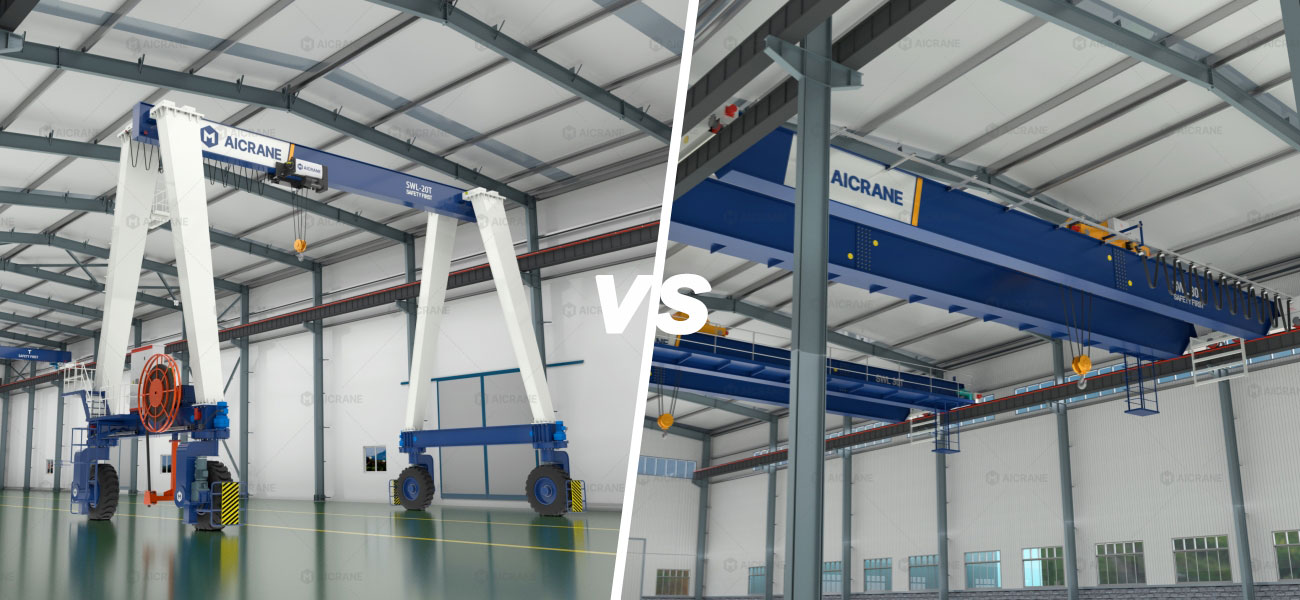
| Feature | Warehouse Gantry Crane | Warehouse Bridge Crane (Overhead Crane) |
|---|---|---|
| Structural Support | Floor-supported; load goes directly to concrete floor, no runway beams required | Supported by runway beams on building columns or steel structure |
| Floor Space | Requires floor travel paths for crane legs | Full unobstructed floor area |
| Mobility | Mobile or semi-mobile options available depending on design | Fixed to runway system; relocation requires modification |
| Installation | Minimal civil work, fast deployment | Requires runway beams and structural preparation |
| Cost & Application | Lower infrastructure cost, suitable for flexible or retrofit warehouses | Higher initial cost, suited for permanent heavy-duty operations |
Engineering Selection Insight
Warehouse gantry cranes are typically used in facilities where structural modification is limited or where operational layouts require flexibility. They offer faster installation and adaptable deployment with minimal building intervention. Warehouse bridge cranes remain a standard solution for permanent industrial buildings that require high-frequency, full-span lifting with stable long-term structural support.
EPC Services for Steel Structure Warehouse with Gantry Crane Integration
Our EPC service integrates the steel structure warehouse, gantry crane system, and operational workflow into a single coordinated engineering solution, ensuring alignment between structural design and material handling requirements.

The Turnkey EPC Framework
Engineering – Customized System DesignWarehouse structure and crane layout are developed based on site conditions, workflow requirements, and lifting specifications to ensure full system compatibility from the design stage.
Procurement – Coordinated Equipment SupplySteel structures, crane systems, and key components are sourced according to project specifications to ensure consistency in performance, durability, and engineering standards.
Construction & Installation – Unified ExecutionA single EPC team manages structural erection, crane installation, and commissioning under one execution plan, reducing interface gaps and improving installation efficiency.
Key Operational Benefits
Coordinated System DesignWarehouse and crane systems are engineered together to ensure efficient workflow and spatial alignment.
Reduced Project ComplexityIntegrated planning minimizes design conflicts, rework, and construction delays.
Expandable Engineering LayoutThe system can support future capacity upgrades, layout modifications, or additional lifting requirements.
The EPC approach ensures the warehouse and gantry crane operate as one engineered system, improving safety, efficiency, and long-term operational flexibility.
FAQs for Warehouse Gantry Crane
What are the concrete floor requirements for operating an indoor warehouse RTG crane?
How can we maximize lifting height in a warehouse with restricted ceiling clearance?
Vertical lifting height under restricted ceilings can be maximized by configuring the system with low-headroom hoists or top-running trolleys.
- Low-Headroom Hoists: For single-girder warehouse gantry cranes, the hoist body wraps around the side of the girder rather than hanging beneath it, reclaiming critical vertical hook travel.
- Top-Running Trolleys: For heavy-duty double-girder setups, the hoist trolley runs on top of rails embedded on the upper face of the girders, utilizing the dead space between the girders to raise the hook point.
Cable reel vs. conductor rail: Which power supply system is best for warehouse gantry cranes?
Enclosed conductor rails are optimal for fixed-path rail-mounted cranes, whereas motorized cable reels are required for flexible rubber-tyred mobile gantry cranes.
- Enclosed Conductor Rails (Busbars): These run along walls or elevated tracks, providing a continuous, compact power source that eliminates hanging wires and presents zero hazard to forklift cross-traffic.
- Cable Reels: These travel with the crane, effectively shielding power and control cables from mechanical damage during long-travel or cross-bay operations where fixed rails are impractical.
How is warehouse gantry crane international shipping and on-site installation managed?
Can an existing industrial facility be retrofitted with a warehouse semi-gantry crane?
From warehouse storage and logistics centers to manufacturing facilities and distribution hubs, AICRANE warehouse gantry cranes are engineered to meet diverse material handling requirements. Contact our specialists today to discuss your application and receive a customized solution designed around your operational needs.